
A practical guide to choosing varieties, planting at the right time, growing well and storing your harvest. Onions, garlic and shallots are reliable crops for beds, allotments and large containers. Give them sun, keep weeds down and, above all, avoid ground that stays waterlogged.
Planting windows vary by variety. Use the planting period on the product page and the label supplied with your order, especially when a selection pack contains varieties chosen according to availability.
SHOP ONIONS, GARLIC & SHALLOTS → SHOP SELECTION PACKS →
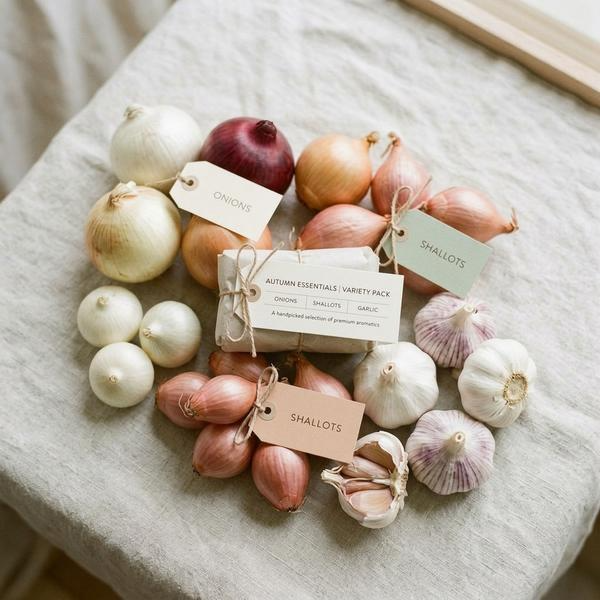
At a glance: when to plant and harvest
- Overwintering onion sets: plant in autumn, usually September–November, choosing a variety sold for overwintering. Harvest is usually June–July.
- Spring onion sets: plant in early to mid-spring once the soil can be worked, following the variety’s instructions. Harvest is usually July–October.
- Garlic: many varieties are planted from mid-autumn to early winter; some suit late winter or spring. Harvest is often late spring to summer, depending on planting time and variety.
- Shallot sets: spring is a dependable planting time, though some varieties are offered for autumn or winter planting. Harvest is usually mid- to late summer.
These are typical UK and Irish timings, not fixed dates. Weather, soil and variety affect the season. RHS onion guide · RHS garlic guide · RHS shallot guide.
Choose what suits your garden
- For an earlier onion crop: Senshyu Yellow is an overwintering onion; Shakespeare is a dependable brown-skinned choice.
- For colour and choice: Red Baron is available for autumn or spring planting; Snowball is a white autumn-planted onion.
- For garlic that keeps well: softneck varieties such as Germidour and Messidrome are useful all-round choices.
- For larger cloves and scapes: hardneck garlic such as Carcassonne Wight or Kingsland Wight gives you the flower stems known as scapes, which are delicious to cook.
- For softneck garlic suited to UK and Irish gardens: compare Picardy Wight and Maddock Wight.
- For a milder, unusual crop: Elephant garlic is related to leek rather than true garlic and grows very large cloves.
- For shallots: compare elongated Longor, golden Golden Gourmet and red Red Biztro. Check each listing for its planting window.
Growing more than one variety? The Overwintering Onion Collection is a convenient choice for a larger autumn onion bed. For three crops in one order, see the Autumn Onion, Shallot & Garlic Selection Pack. Garlic growers can compare the French Garlic Collection or browse the garlic selection packs.
Prepare the ground
Choose an open, sunny position. These crops grow best in fertile soil that holds some moisture but drains freely. Work in well-rotted garden compost before planting if the soil needs improving; do not use fresh manure. Avoid a bed that stays cold and saturated through winter. If drainage is poor, use a raised bed or a suitably deep container with drainage holes.
Try to avoid planting onions, garlic or shallots in ground where alliums have recently grown. If onion white rot has affected a bed, do not plant alliums there again: the disease can persist in soil for many years.
How to plant onion sets
For autumn planting, choose an onion specifically offered for overwintering. Plant spring varieties in spring, rather than assuming all sets can be planted in autumn.
- Plant with the root plate down and pointed tip upwards.
- Space sets about 10–15cm apart, with 20–30cm between rows.
- Set them so the pointed tip is just visible above the soil.
- Firm the soil gently. Water after planting if the ground is dry.
Birds may pull newly planted sets out of loose soil. Check the bed and replant any that have been disturbed; temporary netting can help until they root in.
How to plant garlic
Separate each bulb into individual cloves just before planting, keeping the papery skins intact. Plant only the cloves, not the whole bulb.
- Plant each clove pointed end up, with its tip about 2.5cm below the soil surface.
- Space cloves about 15cm apart, with approximately 30cm between rows.
- Choose a sunny, free-draining bed. In heavy, wet soil, use a raised bed or container; garlic also can be started in modules and planted out when conditions improve.
A container should be deep enough for the roots and cloves—around 25cm or more—and must drain freely. Use a good quality peat-free multipurpose compost for containers or modules.
Softneck, hardneck and elephant garlic
Softneck garlic usually has more, smaller cloves and tends to store for longer. Hardneck garlic generally has fewer, larger cloves around a firm central stem and often a stronger flavour. Hardnecks produce a curling flower stem, or scape.
Cut hardneck scapes while they are young and tender. They are a delicious bonus crop: slice and sauté, roast or grill them. Removing the flower stem also helps the plant direct its energy towards the bulb. Elephant garlic is a different allium, more closely related to leek; its large cloves have a milder flavour.
How to plant shallot sets
Use the season shown for the variety you have bought. Spring planting is suitable for many shallots; some varieties or seasonal packs may be offered for autumn planting. Good drainage is particularly important for any sets planted before winter.
- Choose a sunny position with fertile, free-draining soil.
- Space sets about 15–20cm apart, with 25–30cm between rows.
- Plant with the root end down and the pointed tip just showing above the surface.
- Firm the soil gently and keep the bed weed-free as the sets establish.
Each set divides as it grows to make a cluster of shallots. If you’d like to compare all three Patch varieties, the Shallot Collection includes Longor, Golden Gourmet and Red Biztro.
Care through the growing season
- Weed regularly. Alliums have relatively little leafy cover, so weeds compete for light, moisture and nutrients. Weed by hand close to plants to avoid damaging bulbs.
- Water when needed. Water during prolonged dry spells while plants are actively growing and bulbs are swelling. Avoid keeping the soil saturated. Reduce and then stop watering as the foliage yellows and the crop matures.
- Feed sensibly. Preparing the bed with well-rotted organic matter is usually enough in reasonable soil. If the soil is poor, follow a suitable fertiliser label rather than overfeeding.
- Watch the foliage. A flower stem on onions or shallots is called bolting; remove it, and use those bulbs first because they are less suitable for storage. Garlic scapes can be harvested and eaten.
If growing in containers, keep compost evenly moist during active growth, but never leave pots standing in water. Browse Patch fertilisers and plant care if your soil needs extra support.
Harvesting, curing and storing
Onions
Harvest when the foliage starts to yellow and topple, before it dies down completely. Lift carefully with a fork to avoid bruising. Dry the onions in a single layer with air circulating around them for about two weeks, outdoors in dry weather or in a well-ventilated shed or greenhouse if it is damp. They are ready to store when the skins and necks are dry and papery. Keep sound, fully cured onions in a cool, dry, airy place; use damaged bulbs promptly.
Autumn-planted sets are generally ready in June or July. Spring-planted sets usually follow from summer into early autumn.
Garlic
Harvest when the leaves have yellowed, while some upper foliage may still be green. Do not wait until bulbs split open. Loosen the soil and lift carefully with a fork. Cure bulbs in a single layer in a dry, well-ventilated place, out of excessive heat, for around two to four weeks. When the foliage is dry and rustling, trim it and store the bulbs somewhere cool, dry and airy. Softneck varieties generally keep longer than hardneck varieties.
Shallots
Lift when the leaves yellow, flop over and begin to die back, usually in mid- to late summer. Loosen clusters gently to avoid bruising, then separate them. Cure in a single layer with good airflow—often around two weeks, longer if the weather is damp—until skins and foliage are dry and papery. Store only firm, undamaged bulbs in a cool, dry, well-ventilated place.
Common problems and what to do
- Sets or cloves keep coming loose: birds may be pulling them from the soil. Replant them and cover the bed temporarily with netting until rooted.
- Bulbs rot or fail in winter: the ground may be too wet. Improve drainage, use raised beds or containers, and avoid planting into saturated soil.
- Garlic forms one undivided bulb: some varieties need a period of winter cold to divide properly. Choose a variety suited to your planting season and follow its instructions.
- Onions or shallots send up flower stems: this is bolting. Remove the stem and use that bulb first rather than relying on it for long storage.
- Orange raised spots on leaves: this may be rust, a fungal disease affecting garlic and other alliums. Avoid wetting foliage when watering, keep plants well spaced and remove badly affected material.
- Yellowing, wilting plants with decaying roots or bulbs: this can indicate serious allium disease, including white rot. Remove affected plants and soil from the immediate area carefully; do not move soil or sets from an affected bed to clean ground. White rot can persist for many years, so do not grow alliums in affected soil.
- Bulbs soften or rot in storage: they may have been bruised, stored before fully curing, or kept somewhere warm or damp. Use damaged bulbs promptly and check stored crops regularly.
For help identifying a specific problem, compare symptoms with the RHS onion guide, RHS garlic guide and RHS shallot guide.
Plan your allium bed
Leave enough room to weed between rows and give each bulb space to mature. Where possible, grow alliums in a different part of the garden each year. Do not plant into ground known to have white rot. If you are short of space, onions and garlic can be grown in large, well-drained containers; shallots generally crop best in open ground or raised beds.
For a fuller kitchen garden, read our potato growing guide, browse vegetable seeds, or plan your next potato crop with our seed potatoes.
Choose your planting stock
Whether you are filling a bed or trying a few varieties in containers, start with planting stock selected for growing—not supermarket bulbs. Browse the full Patch onions, garlic and shallots range, or go straight to selection packs to grow more than one crop or variety.
SHOP ONIONS, GARLIC & SHALLOTS → SHOP SELECTION PACKS →
Growing advice is a guide; exact timing varies with variety, local weather and soil conditions. Always follow the planting instructions supplied with your chosen variety.